Hawaii DOE School Calendar
Important Dates
Fall Break October 5-9, 2019
Thanksgiving November 26-27, 2019
Christmas Break December 21, 2019- January 4, 2020
Spring Break March 15-19, 2020
Last Day of Class May 28, 2020
Medical Advancement Efforts to Treat Hearing Loss
2019
Stanford University
Website:http://hearinglosscure.stanford.edu/our-mission/
Program:Stanford Initiative to Cure Hearing Loss (SICHL)
- Stem Cell Therapy
- Gene Therapy
- Molecular Therapy
- Neural Stimulation
Harvard Medical School
Website:https://bertarelli.hms.harvard.edu/news/new-published-paper-support-bertarelli-program-improved-tmc1-gene-therapy-restores
Program:Restore Hearing Loss After Noise Damage
- Gene Therapy- Regrown hair cells in ears of mice, which could be a promising therapy for Deafness
Hearing Loss Clinical Trial
Website:http://www.cordblood.com
Program:Cord Blood Registry (CBR)
- Acquired Hearing Loss and Newborn Stem Cells Trial
Novartis
Website:http://www.novartis.com
Program:Treatment where Harmless Virus Carries a Gene into the Inner Ear to Stimulate New Growth of Hair Cells
- Health Care
- Research and Development
- Innovation Practices
Hearing Loss Clinical Trial
Website:http://www.healthline.com/health-news/gene-therapy-may-help-with-hearing-loss#1
Program:Genetic Manipulation through Gene Therapy
- Protein Manipulation to Restore Hair Cells
Columbia University Medical Center
Website:http://www.entcolumbia.org/world-s-first-gene-therapy-trial-hearing-loss
Program:Novartis-Sponsored Clinical Trial
- Gene Therapy- Gene will stimulate the growth of new hair cells and, eventually, restore some hearing capacity
*It should be noted that electronic documents consistently change; therefore, as this document ages, URLs may expire. As of 08/2019 the websites are current.
Frequently Asked Questions
- Newborn hearing screening is a quick procedure that checks your baby’s hearing and identifies those babies who need further testing. It is performed on babies prior to discharge from hospital.
- Why is newborn Hearing Screening important?
- Newborn hearing screening is the first step in determining how your baby hears. Babies use their hearing to learn to talk, so it’s important to identify hearing loss early. Although it’s unlikely that your child has hearing loss, it is helpful to know how your baby hears as soon as possible.
- How is Newborn Hearing Screening done?
- Newborn hearing screening is painless and takes about 15 minutes. It should be done while your baby is asleep in a quiet environment. A computer based screener is used to record each ear’s response to sound. It automatically gives a pass or refer result and does not require your baby to respond. There are 2 ways to screen your baby’s hearing:
- Automated Brainstem Response (ABR): Three sensors are placed on your baby’s head and soft sounds are presented through earphones.
- OtoAcoustic Emissions (OAE): Soft sounds are presented through foam tips which are placed in your baby’s ears.
- What do the Newborn Hearing Screening results mean?
- Pass means that your baby has adequate hearing at the time of the screening. Some babies who pass the screening may require further testing due to family history or medical conditions.
- Refer means that your baby did not pass the screening. If your baby did not pass the first screening, a second one will be done. If your baby does not pass or “refers” on the final hearing screening, your baby will need to be scheduled for diagnostic hearing testing with an audiologist. The audiologist will be able to determine if there is a hearing loss. It is important that you follow up with your audiologist to have this test completed as soon as possible.
- Sensorineural Hearing Loss –
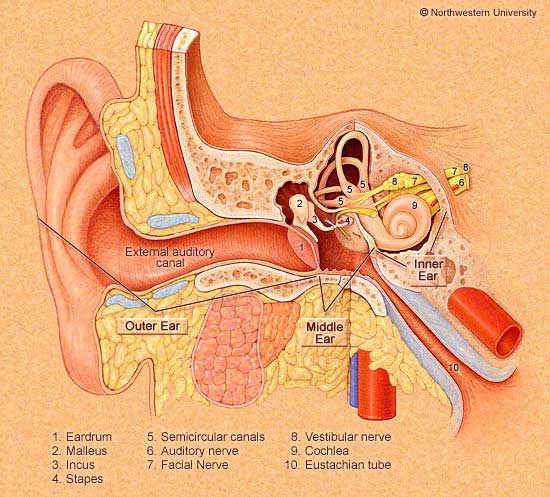
- Sensorineural hearing loss (SNHL) occurs when there is damage to the inner ear (cochlea), or to the nerve pathways from the inner ear to the brain. Most of the time, SNHL cannot be medically or surgically corrected. This is the most common type of permanent hearing loss.
- Conductive Hearing Loss –
- Conductive hearing loss occurs when sound is not conducted efficiently through the outer ear canal to the eardrum and the tiny bones (ossicles) of the middle ear. Conductive hearing loss usually involves a reduction in sound level or the ability to hear faint sounds. This type of hearing loss can sometimes be corrected medically or surgically, though it can also be permanent.
- Sensorineural and conductive losses can sometimes occur simultaneously, this type of loss is referred to as a mixed loss.
- Hearing Loss can be unilateral (one ear affected only) or bilateral (both ears affected). All hearing loss is significant and can impact learning.
- Newborn hearing screening is the first step in determining how your baby hears. Babies use their hearing to learn to talk, so it’s important to identify hearing loss early. Although it’s unlikely that your child has hearing loss, it is helpful to know how your baby hears as soon as possible.
- Newborn hearing screening is painless and takes about 15 minutes. It should be done while your baby is asleep in a quiet environment. A computer based screener is used to record each ear’s response to sound. It automatically gives a pass or refer result and does not require your baby to respond. There are 2 ways to screen your baby’s hearing:
- Automated Brainstem Response (ABR): Three sensors are placed on your baby’s head and soft sounds are presented through earphones.
- OtoAcoustic Emissions (OAE): Soft sounds are presented through foam tips which are placed in your baby’s ears.
- Pass means that your baby has adequate hearing at the time of the screening. Some babies who pass the screening may require further testing due to family history or medical conditions.
- Refer means that your baby did not pass the screening. If your baby did not pass the first screening, a second one will be done. If your baby does not pass or “refers” on the final hearing screening, your baby will need to be scheduled for diagnostic hearing testing with an audiologist. The audiologist will be able to determine if there is a hearing loss. It is important that you follow up with your audiologist to have this test completed as soon as possible.
- Sensorineural Hearing Loss –
- Sensorineural hearing loss (SNHL) occurs when there is damage to the inner ear (cochlea), or to the nerve pathways from the inner ear to the brain. Most of the time, SNHL cannot be medically or surgically corrected. This is the most common type of permanent hearing loss.
- Conductive Hearing Loss –
- Conductive hearing loss occurs when sound is not conducted efficiently through the outer ear canal to the eardrum and the tiny bones (ossicles) of the middle ear. Conductive hearing loss usually involves a reduction in sound level or the ability to hear faint sounds. This type of hearing loss can sometimes be corrected medically or surgically, though it can also be permanent.
- Sensorineural and conductive losses can sometimes occur simultaneously, this type of loss is referred to as a mixed loss.
- Hearing Loss can be unilateral (one ear affected only) or bilateral (both ears affected). All hearing loss is significant and can impact learning.


There are a few different hearing tests that your audiologist may use for your child depending on age and developmental level; these may be used alone or together to test hearing and auditory function:
Behavioral Hearing Tests
- Behavioral Observation Audiometry (BOA)
- Visual Reinforcement Audiometry (VRA)
- Conditioned Orientation Reflex (COR) Audiometry
- Conditioned Play Audiometry (CPA)
- Conventional Audiometry
Tests of Auditory Function
- Acoustic Immitance: This may include tympanometry, acoustic reflexes or acoustic reflex decay). These tests check the status of the middle ear system.
- Otoacoustic Emissions (OAE): This tests the function of the outer hair cells in the inner ear
- Auditory Brainstem Response (ABR): This tests the Auditory nerve function and estimates the peripheral hearing levels. This test may be performed either sedated or unsedated (birth to 5 months)